 Wichita Egress Windows
 Window Well Replacement in Wichita
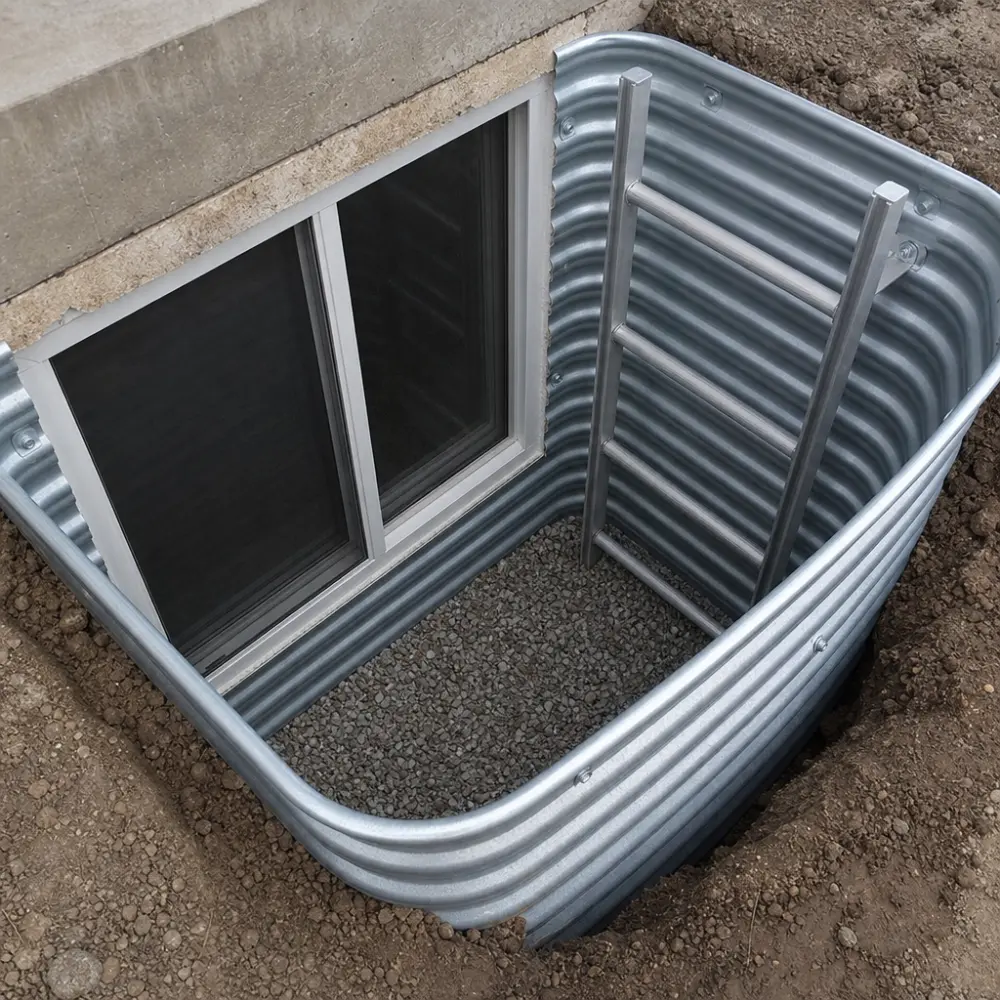
Window well replacement in Wichita runs $1,000 to $3,000 per well: a code-sized well anchored to the foundation, a ladder where the depth requires one, a rated cover, and, underneath, the 12 inches of washed gravel the Wichita/Sedgwick County code requires. A liner inside a still-sound steel well is $400 to $900. The job takes a day, needs no concrete cutting, and usually no permit.
Wichita’s wells fail the way wells fail everywhere, only faster, because the ground under most of the county is Group D silty clay that holds water against bare steel at the soil line through every spring. Here is what the local code asks of a well, when a well has to come out, and what goes in its place.
What the Wichita code requires of a well
The model IRC sets the size: at least 9 square feet of horizontal area and a projection of at least 36 inches from the wall. The Wichita amendment leaves those alone and then goes further than the model code in three places:
- Ladder (Sec. 2.4.220): any well deeper than 44 inches needs a permanently affixed ladder or steps, usable with the window fully open, rungs at least 12 inches wide, projecting at least 3 inches, spaced no more than 12 inches on center for the full height of the well. The model code allows 18 inches. A ladder that passed in another county can fail here.
- Cover or guardrail (same section): any well deeper than 30 inches needs a guardrail built to R312 or a protective cover rated for 20 pounds per square foot. The cover must have an emergency egress hatch above the ladder that opens with no more than 30 pounds of force, no keys, one motion. On a full-height basement every well trips this.
- Drainage (Sec. 2.4.225, R310.2.3.2): the well drains into the foundation drainage system or an approved alternative, and where no foundation drain exists, the entire well area gets a minimum of 12 inches of washed gravel or crushed rock below the floor level.
The code page has the full text alongside the model code.
When the well has to come out
| What we find | The job | Typical cost |
|---|---|---|
| Steel perforated at the soil line, well still square to the wall, correct size | Liner | $400 to $900 |
| Well pulled off the wall, heaved, or tipping | Full replacement | $1,000 to $3,000 |
| Well undersized for egress (under 36 inches of projection, or under 9 square feet) | Full replacement, sized to code | $1,000 to $3,000 |
| Well sound, base holding water | Drainage rebuild | $300 to $1,000 |
| Deep well, no ladder, steel accepts an anchor | Bolt-on ladder | $200 to $500 |
| Missing or broken cover on a well over 30 inches | Rated cover with hatch | $150 to $600 |
The screwdriver test decides between the first two rows. Push a flat screwdriver into the steel an inch above the soil line and again an inch below. Solid steel under the scale means a liner is on the table. A screwdriver that goes through means the wall is gone. The rusted well page has the full check.
The replacement, step by step
- Pull the old well and dig out the base. The bottom of the hole comes out 12 to 18 inches below the sill so the new gravel bed has room.
- Find the outlet. If the house has a footing drain that still flows, a perforated leg runs from the gravel down to it. If the drain is silted shut, or the house predates footing drains, which is most of the pre-1940 stock in College Hill, Riverside, and Delano and a lot of the 1950s ranch belt, we build a deep gravel dry well beside the window well instead.
- Lay the gravel. Washed rock over fabric, a minimum of 12 inches across the whole well area per the local code, more where the dry well is the outlet.
- Set and anchor the new well to the foundation with masonry anchors, sealed at the wall so soil and water stop coming through the joint. Wichita’s amended R403.1.8 treats expansive soil as a design condition, and a well set loose in Goessel or Rosehill clay walks off the wall in a few wet-dry cycles.
- Ladder and cover. Ladder over 44 inches, rungs 12 inches on center. Cover or guard over 30 inches, rated, with the hatch above the ladder.
- Backfill with gravel, not the clay we dug out, and grade the surface away from the house.
Steel or composite
Two families of well go in the ground here, and the honest comparison is on the brand pages: galvanized corrugated steel, the value option with a rust clock that a real gravel bed stretches by decades, and composite wells, which cost more, have no rust clock, and often carry molded steps that satisfy the 12-inch rung rule as built. On a utility-space well, steel. On a well you see from a finished room, or one that has to be tall on a sloped lot, composite usually earns the difference. Either way the thing that decides service life is under the well, not on the flange.
Relining instead of replacing
A liner is a new well wall fitted inside the old one. The rusted corrugated steel stays in the ground as a shell, a composite or galvanized liner is set inside it, anchored to the foundation, and sealed at the wall. The hole stays where it is, which is why it costs roughly half of a replacement and takes half a day. It is the wrong answer in three cases: a well that has moved, a well that is undersized for egress, and a base that has silted solid, because a tidy liner over a dead gravel bed still floods.
Timing
Well work is dig work, and Wichita digs most of the year with a 24-inch frost line. The two slow windows are the hard-freeze weeks of midwinter and May-June, when NOAA’s normals put over ten inches of rain on the city in eight weeks and a hole in this clay is a hole full of water. If your well filled this spring, get measured in late summer and have it rebuilt on dry ground.
Every number above is on the pricing page, and the well cost calculator prices your combination. Send one photo straight down into the well and one from six feet back, and we will usually tell you on the first call whether you are looking at a liner, a rebuild, or a replacement. We do this work across Wichita, Derby, Haysville, Maize, and the rest of the county.
Frequently Asked Questions
What does a window well replacement cost in Wichita?
$1,000 to $3,000 per well installed, into an existing compliant opening. Galvanized corrugated steel with a new 12-inch gravel bed sits at the low end; a composite well, a deep well needing a ladder, or a drainage rebuild with a dry well pushes toward the top. A liner inside a still-sound steel well is $400 to $900. No permit is normally needed when the opening itself is not changed.
What does Wichita's code require of a window well?
For an egress well: at least 9 square feet of area and 36 inches of projection (the model IRC figures, unchanged locally); a permanently affixed ladder in any well deeper than 44 inches, rungs at least 12 inches wide, projecting 3 inches, spaced no more than 12 inches on center; a guardrail or a 20-psf-rated cover with an egress hatch on any well deeper than 30 inches; and a tie-in to the foundation drain or 12 inches of washed gravel under the entire well.
Steel or composite?
Galvanized steel is the value pick and, over a real gravel bed, gives a long service life before the soil line rusts through. Composite costs more and has no rust clock, and its molded steps can satisfy the 12-inch rung rule as built. On a finished basement or a well you look at from a living room, composite usually earns it. On a utility-space well, steel usually does. We are not a dealer for either.
Can you reline my well instead of replacing it?
If the steel still holds its shape, passes a screwdriver test at the soil line, and the anchors are tight, yes: a liner is $400 to $900 and a half day. If the well has pulled off the wall, heaved, or is undersized for egress, a liner hides a real failure and we will say so.
Does replacing the well need a permit?
Usually not on its own, because nothing structural changes: the opening and the window stay as they are. If the replacement is part of enlarging the opening or adding a new one, it rides on that job's MABCD permit. Either way, the well has to meet the local ladder, cover, and drainage rules, and if the room is used for sleeping, an inspector will measure it at the next sale.
More egress services
Areas we serve
- Wichita, KS
- Egress Window Installation in Andover, Kansas
- Egress Window Installation in Derby, Kansas
- Egress Window Installation in Goddard, Kansas
- Egress Window Installation in Haysville, Kansas
- Egress Window Installation in Maize, Kansas
- Egress Window Installation in Park City, Kansas
- Egress Window Installation in Valley Center, Kansas